Corporate events
Restaurant Holiday Party Entertainment That Fits
Plan restaurant holiday party entertainment around private dining room access, meal service, sound, and the moment guests can give a show their attention.
In this article
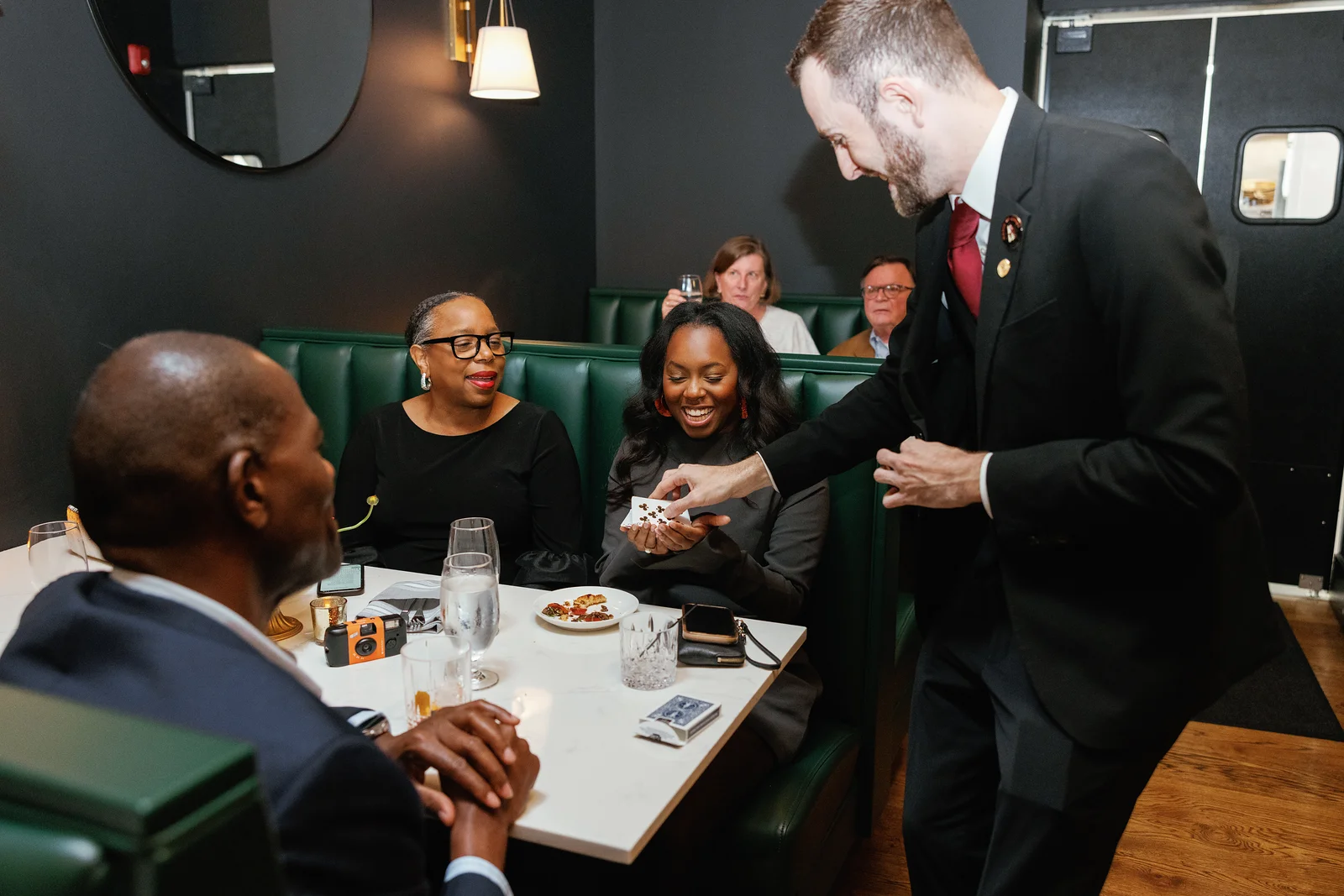
Restaurant holiday party entertainment needs to fit the dining room's service pattern. Before choosing a performance window, confirm access with the restaurant, understand how food and drinks move through the space, and check whether guests can comfortably see and hear. I usually recommend giving active eating its own time. A reception period or an agreed moment after the meal may provide a better place for magic.
Confirm the restaurant holiday party entertainment plan
A private room reservation tells you where your party will dine. It does not answer every question about bringing in entertainment. Ask the restaurant's event contact what arrangements are possible for your particular booking.
Discuss whether outside performers can attend, when they can enter, who meets them, and which parts of the space are included. If the room is shared, partly screened, or connected to a busy public area, say so when you contact me. Those details affect how the audience can gather.
I would also ask whether the final layout will match the diagram or photographs you have seen. A room may be arranged differently for a seated meal than for a reception. Work from the actual party setup.
Keep the restaurant contact involved as the entertainment plan takes shape. That person can help connect your preferred experience with the room arrangements and service your reservation includes.
Map the route that dinner service needs
The most obvious open area is not always available for a performance. It may be where servers turn with trays, where guests line up for drinks, or where staff stage the next course.
Ask the restaurant contact to identify those routes before deciding where people will watch. A close-up group can grow as nearby guests become interested. Leave enough practical space for that group to form without pushing staff into a different route.
For example, a host could consider a social area at one end of a private room, then discover that it sits between the kitchen door and every table. That would be a reason to reconsider the position, even if the area looks attractive in a photograph.
Also consider guests moving between seats, restrooms, and the bar. The right position should support the room's everyday movement, not require the restaurant to stop functioning around the entertainment.
Choose the window by service activity
I generally recommend avoiding magic while people are actively eating. That advice is especially relevant in a restaurant, where the meal itself is a central part of the celebration.
Ask how the dinner will be served. A plated sequence, shared dishes, and an open buffet create different patterns of movement and attention. You do not need to redesign the menu around entertainment, but you do need to understand when guests will be settled.
A pre-dinner gathering may allow small groups to enjoy close-up magic before taking their seats. A later show may be possible once the busiest service has finished. Confirm either idea with the restaurant and performer before putting it in the invitation.
For example, a planner could discuss a focused performance after the main meal, provided the room can pause other announcements and guests can see comfortably. The service lead should help identify a realistic cue instead of relying on a guessed course duration.
Listen to the room beyond its closed door
A private room can still receive sound from the bar, kitchen, adjoining dining areas, or house music. Visit during a comparable service period if you can, or ask the restaurant to describe the usual sound conditions.
Think about how guests will hear one another, not only whether the room has a speaker. A small group may need a calmer corner for conversational interaction. A gathered audience may require a different sound arrangement that must be coordinated with the venue.
I perform at Nashville events with live musicians and use more visual magic when that fits the setting. That does not remove the value of a sensible sound plan. Ask who controls the music in the private room and whether it can be adjusted for an agreed performance window.
Lighting matters too. Guests should be able to see the performance comfortably without a last-minute scramble to change the atmosphere of the entire restaurant.
Decide how a seated group will watch
A long dining table can be wonderful for dinner while being awkward for a shared close-up performance. People at opposite ends may have very different views. Before assuming everyone can watch from their dining seat, discuss the arrangement.
With a small gathering, a focused show may make more sense than trying to create several strolling groups that do not really exist. The exact format should follow the audience and room. My comparison of close-up and stage formats can help distinguish the attention patterns.
Questions worth resolving include:
- Will guests stay seated or move to another part of the room?
- Are decorations or place settings blocking the view?
- Can anyone who needs a seat remain comfortable?
- Will moving chairs affect service or other diners?
Agree any furniture changes with restaurant staff. A performance plan should work within the room arrangements the restaurant has approved.
Give the host and restaurant one shared handoff
The person coordinating your booking and the person running service that evening may not be the same. Make sure the agreed plan reaches whoever will be present when the party takes place.
I suggest a short shared note covering the performance location, arrival arrangements, intended window, service cue, and day-of contact. Add any sound or room changes that the venue has explicitly agreed to. If something is still undecided, resolve it before treating it as part of the plan.
For a company celebration, my corporate event page provides context for the entertainment. When you are ready to discuss your private dining room, send me the restaurant and event details. Include the seating arrangement and meal sequence, so we can consider the space your guests will actually use.
Frequently asked questions
Can I add a magician to any restaurant reservation?
Ask the restaurant first. A reservation alone does not confirm outside entertainment, access arrangements, or permission to change the room. Get the relevant details from the event contact, then discuss the audience and setup with the performer.
Does a small private dining room need strolling magic?
Not necessarily. If everyone is already gathered around one table, a focused show may be more appropriate. The choice depends on how the audience can see and listen, not simply on calling the event a dinner party.
Should guests keep eating while the show happens?
I generally advise giving the meal and performance separate attention. Coordinate with the service lead to find a suitable window before dinner or after active service. Confirm the cue based on the actual dining plan rather than assuming a printed mealtime will be exact.
Where to next
See the work, or read more notes.